publications
publications by categories in reversed chronological order. generated by jekyll-scholar.
2026
- ACL2026
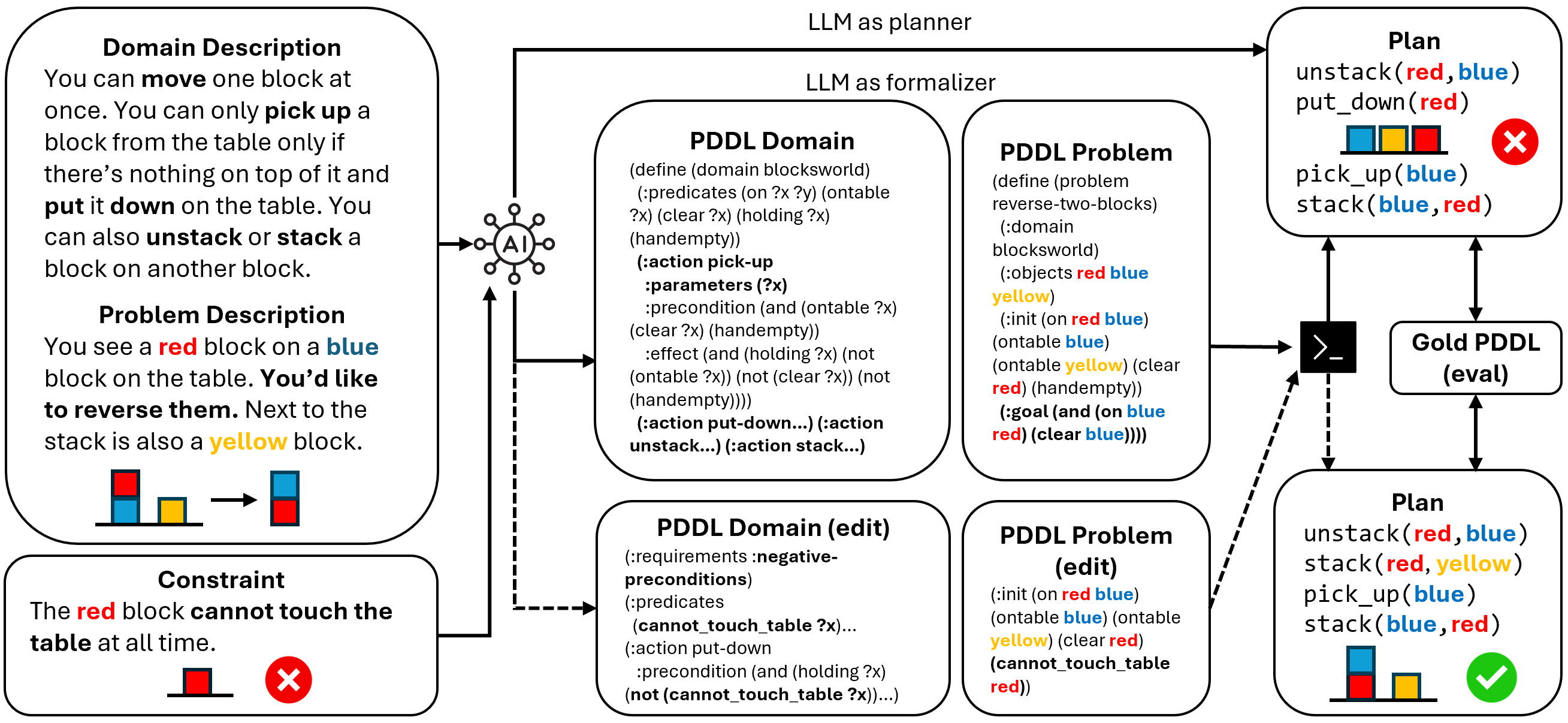
Language Model as Planner and Formalizer under ConstraintsCassie Huang, Stuti Mohan, Ziyi Yang, Stefanie Tellex, and Li Zhang2026LLMs have been widely used in planning, either as planners to generate action sequences end-to-end, or as formalizers to represent the planning domain and problem in a formal language that can derive plans deterministically. However, both lines of work rely on standard benchmarks that include only generic and simplistic environmental specifications, leading to potential overestimation of the planning ability of LLMs and safety concerns in downstream tasks. We bridge this gap by augmenting widely used planning benchmarks with manually annotated, fine-grained, and rich natural language constraints spanning four formally defined categories. Over 4 state-of-the-art reasoning LLMs, 4 formal languages, and 4 datasets, we show that the introduction of one-sentence constraints consistently halves performance, indicating current LLMs’ lack of robustness and an avenue for future research.
- arXiv
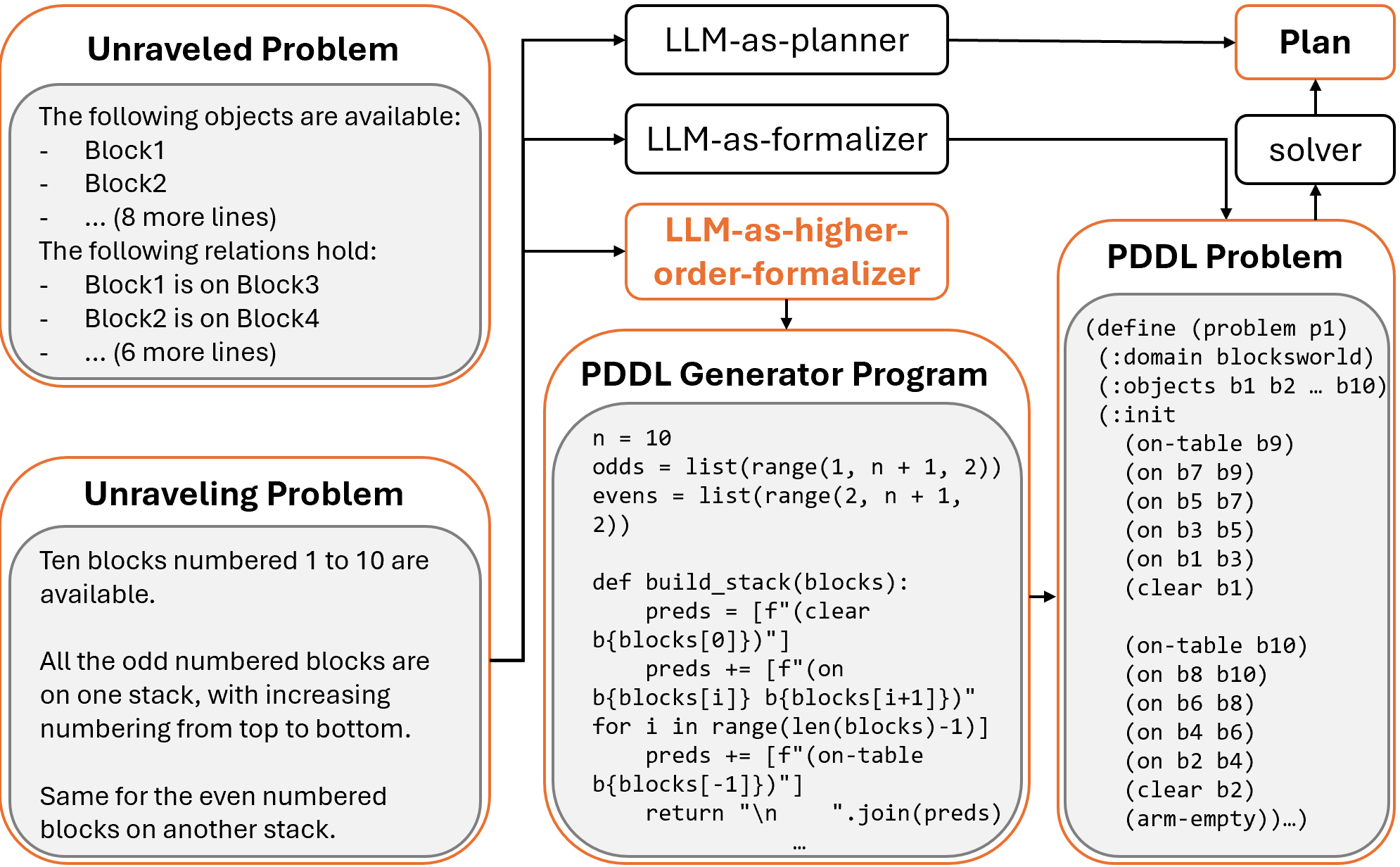
Language Model Planners do not Scale, but do Formalizers?Owen Jiang, Cassie Huang, Ashish Sabharwal, and Li Zhang2026Recent work shows overwhelming evidence that LLMs, even those trained to scale their reasoning trace, perform unsatisfactorily when solving planning problems too complex. Whether the same conclusion holds for LLM formalizers that generate solver-oriented programs remains unknown. We systematically show that LLM formalizers greatly out-scale LLM planners, some retaining perfect accuracy in the classic BlocksWorld domain with a huge state space of size up to 10^165. While performance of smaller LLM formalizers degrades with problem complexity, we show that a divide-and-conquer formalizing technique can greatly improve its robustness. Finally, we introduce unraveling problems where one line of problem description realistically corresponds to exponentially many lines of formal language such as the Planning Domain Definition Language (PDDL), greatly challenging LLM formalizers. We tackle this challenge by introducing a new paradigm, namely LLM-as-higher-order-formalizer, where an LLM generates a program generator. This decouples token output from the combinatorial explosion of the underlying formalization and search space.
2025
- ACL2025
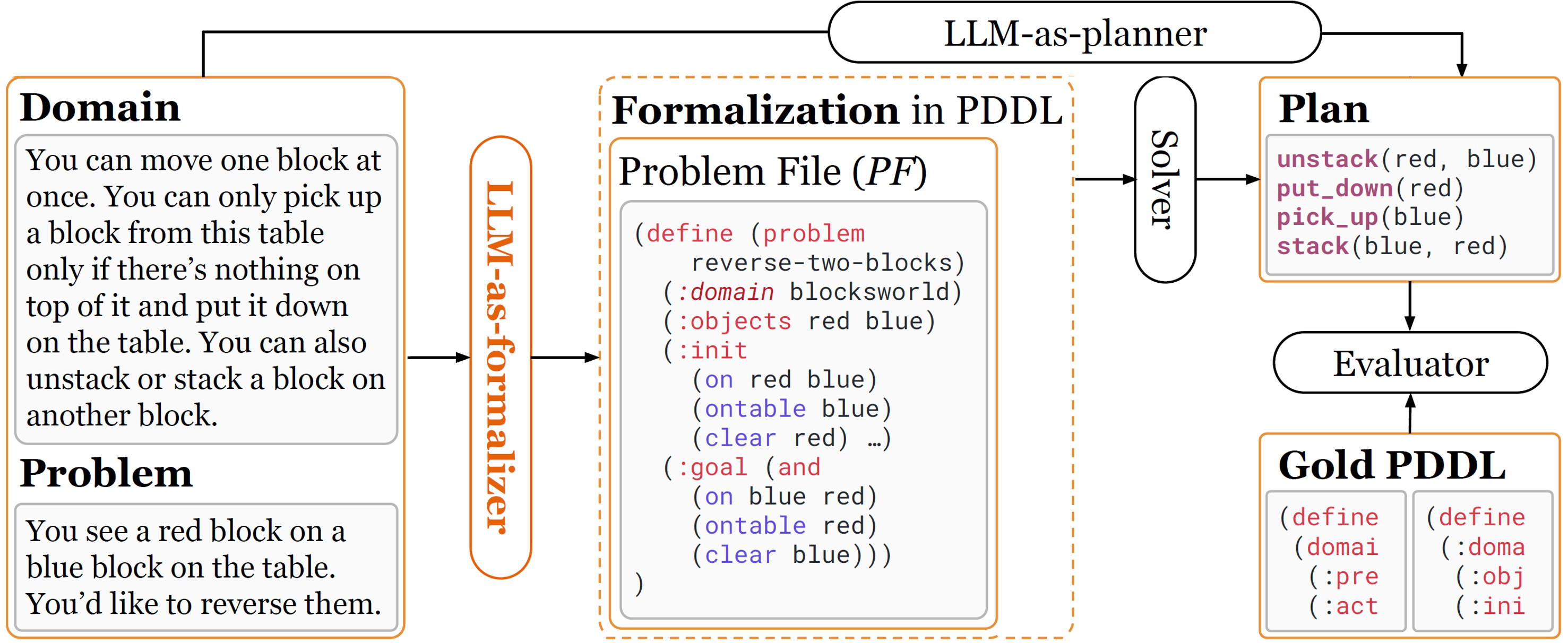
On the Limit of Language Models as Planning FormalizersCassie Huang and Li ZhangIn Proceedings of the 63rd Annual Meeting of the Association for Computational Linguistics (Volume 1: Long Papers), Jul 2025Large Language Models have been found to create plans that are neither executable nor verifiable in grounded environments. An emerging line of work demonstrates success in using the LLM as a formalizer to generate a formal representation of the planning domain in some language, such as Planning Domain Definition Language (PDDL). This formal representation can be deterministically solved to find a plan. We systematically evaluate this methodology while bridging some major gaps. While previous work only generates a partial PDDL representation, given templated, and therefore unrealistic environment descriptions, we generate the complete representation given descriptions of various naturalness levels. Among an array of observations critical to improve LLMs’ formal planning abilities, we note that most large enough models can effectively formalize descriptions as PDDL, outperforming those directly generating plans, while being robust to lexical perturbation. As the descriptions become more natural-sounding, we observe a decrease in performance and provide detailed error analysis.
- ACL2026
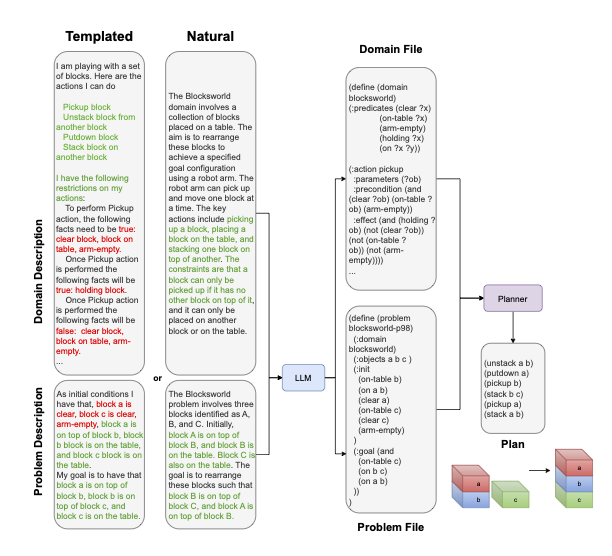
Unifying Inference-Time Planning Language GenerationPrabhu Prakash Kagitha, Bo Sun, Ishan Desai, Andrew Zhu, Cassie Huang, Manling Li, Ziyang Li, and Li Zhang2025A line of work in planning uses LLM not to generate a plan, but to generate a formal representation in some planning language, which can be input into a symbolic solver to deterministically find a plan. While showing improved trust and promising performance, dozens of recent publications have proposed scattered methods on a variety of benchmarks under different experimental settings. We attempt to unify the inference-time LLM-as-formalizer methodology for classical planning by proposing a unifying framework based on intermediate representations. We thus systematically evaluate more than a dozen pipelines that subsume most existing work, while proposing novel ones that involve syntactically similar but high resource intermediate languages (such as a Python wrapper of PDDL). We provide recipes for planning language generation pipelines, draw a series of conclusions showing the efficacy of their various components, and evidence their robustness against problem complexity.